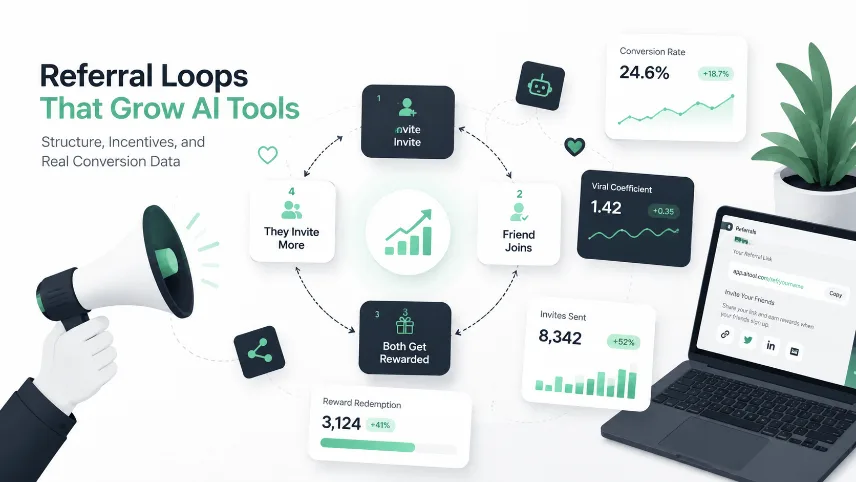
Most AI tools don't have a distribution problem at launch. They have a retention problem disguised as a distribution problem. Early users arrive through Product Hunt, a newsletter mention, or a founder's LinkedIn post, and then quietly churn before they ever refer anyone. The referral loop never activates because the conditions for it were never built.
Referral growth isn't automatic for AI products the way it sometimes is for consumer social apps. The use cases are more specific, the value takes longer to demonstrate, and users are often solo professionals or small teams who don't naturally evangelize tools they use privately. Building a referral loop that actually works requires thinking carefully about timing, incentive structure, and what you're asking users to share, and with whom.
This article breaks down how high-growth AI tools can build referral systems that compound, with directional benchmarks, caveats, and structural principles that translate across product categories.

Why Most AI Referral Programs Underperform
The most common mistake is treating referral as a marketing channel rather than a product feature. When referral is bolted on after launch as a "Share this link" button in the settings menu or a discount code in a monthly email, it generates activity without generating loops.
A loop requires that referred users experience enough value to refer others in turn. That chain only works if the referral mechanism is embedded in moments of genuine product satisfaction, not placed where users are most likely to ignore it.
AI tool visibility in competitive markets depends increasingly on this word-of-mouth infrastructure. Paid acquisition costs for many SaaS and AI-adjacent products remain a pressure point as markets become more crowded. Referral-driven growth, when structured correctly, can produce lower CAC and higher LTV than paid channels, but it requires upfront product and incentive design that most teams underinvest in.
The Anatomy of a High-Converting Referral Loop
Trigger: The Moment of Peak Value
Every strong referral loop is anchored to a specific product moment, the point at which a user experiences enough value that sharing feels natural rather than transactional.
For AI productivity tools, this moment is often output-driven: the first time a user generates something they're genuinely proud of and want to show someone. Tools that help users animate still images with AI have a natural sharing moment baked into the output itself, the animation is inherently shareable, and sharing it implicitly demonstrates the tool.
Tools that turn text into video with AI similarly have a clear sharing moment when users create a compelling video from their written content. These moments of peak value not only encourage users to share the tool with others, but also reinforce the value of the tool itself in their minds.
Not every AI tool has an output that is this naturally viral. For tools with less visible outputs, such as data analysis, workflow automation, and document processing, the trigger needs to be engineered more deliberately, often through milestone notifications, usage summaries, or results dashboards that give users something concrete to share.
Incentive: Matching Reward to User Psychology
Referral incentives fail when they're misaligned with what users actually value. A discount on a paid plan doesn't motivate a free-tier user who hasn't yet decided to upgrade. Extended credits don't excite a user who hasn't exhausted their existing allocation.
Effective incentive design starts with user segmentation:
For power users and early adopters: Exclusive feature access or priority status often outperforms cash-equivalent rewards. These users are motivated by identity and status within a product community, and an incentive that signals insider standing may convert better than a generic discount.
For professional users in workflow tools: Time-saving equivalents work well. Framing a referral reward as "one month free, equivalent to X hours of work automated" ties the incentive directly to the value proposition rather than presenting it as a generic offer.
For users still in the evaluation phase: Two-sided incentives, where both referrer and referred user receive a benefit, reduce the social risk of the referral and may increase the likelihood that the referred user converts to an active account.
Mechanics: Reducing Friction at Every Step
The technical execution of a referral system matters as much as the incentive structure. Referral flows with more than two steps between "I want to share this" and "link sent" can lose a significant percentage of potential referrers at each additional step.
Prioritize these mechanical elements:
Generate unique referral links automatically at the point of peak value, without requiring users to navigate to a separate referral page or enter information they've already provided during signup.
Build in pre-written share copy that users can deploy immediately. Most people who want to recommend a tool don't want to write their own message, and the quality of organic referral language can affect conversion rates among referred users.
Surface referral status and progress in the product dashboard so users can see how many people they've referred and what reward they're tracking toward. Visible progress toward a threshold is consistent with goal-gradient research, which suggests that people often increase effort as they perceive themselves getting closer to a goal.
Research Insight: Social Proof and Conversion in Digital Products

Consumer trust in advertising in the UK has reached a five-year high, with 40% of people saying they trust ads in 2025, up slightly from 39% in 2024 and from 31% in 2021. Yet that trust remains fragile: only 11% are very trusting, and 29% are fairly trusting, while 25% actively distrust ads and 33% sit neutrally between trust and distrust. Credos' 2025 data show that positive and negative drivers of trust are now perfectly balanced at 50/50, with "suspicious advertising" (scams, misleading or undisclosed ads, greenwashing, and image manipulation) a major source of distrust, and enjoyment emerging as the strongest single driver of trust. This combination of rising but brittle trust helps explain why social proof and credible third-party signals often outperform ads alone in driving conversions for digital products.
For AI startups, this brittle trust in advertising makes social proof more than a nice-to-have; referrals and recommendations effectively "import" trust from a known, credible source in a way paid acquisition struggles to match. A referred user shows up with much of the trust-building already done, shortening the path from first touch to activation and boosting retention in the critical first 30 days, when most products are still fighting to overcome baseline skepticism about new AI tools.
Conversion Benchmarks Worth Knowing
Referral program performance varies significantly by product category, incentive type, and trigger placement, but working benchmarks help teams calibrate expectations and identify underperformance early.
Across SaaS and AI tool categories, reliable public AI-specific referral benchmarks are limited, so the following should be treated as directional planning ranges rather than universal averages:
Referral link click-through rates of 15% to 25% are plausible for well-structured programs, but this range has not been verified as a category-wide AI benchmark. Programs with one-sided rewards or weak trigger placement may perform lower, but teams should validate this against their own funnel data.
Referred user activation rates, the percentage of referred users who complete a meaningful product action within 7 days, should be tracked separately from organic activation. Public evidence supports the broader idea that referred customers can be more valuable and more loyal, but a 40% to 60% AI-tool activation average is unverified.
Referral-to-paid conversion rates for referred users may exceed those for non-referred users in freemium AI products, reflecting the trust-transfer effect documented in social-proof research. However, the original 10% to 20% range should be treated as unverified unless supported by the company's own cohort data.
For teams building toward AI startup growth, these benchmarks suggest that referral programs can meaningfully compress CAC when they are measured rigorously and underperforming steps are optimized iteratively rather than left static after launch.
Building Referral Into Your Product Roadmap

Referrals shouldn't live exclusively in the marketing team's backlog. The highest-performing referral programs at AI companies are treated as product features with their own roadmap, metrics, and iteration cycles.
Practical steps for embedding referral into product development:
Map your user journey to identify two or three natural sharing moments before building any referral mechanics. The sharing moment should precede the incentive design, not follow from it.
A/B test incentive framing before incentive value. How a reward is described often affects conversion more than its dollar equivalent. "Get one month free" and "Save $29" can produce different conversion rates even when the economic value is identical.
Build referral analytics into your core product dashboard from the start, tracking referred user behavior separately from organic cohorts to understand whether your referral traffic is generating durable users or one-time signups.
For teams building technical literacy around growth systems and online distribution, the Research.com affordable online AI bachelor's degree guide lists and describes curricula that may include computer science, machine learning, and data analytics. It may be a useful context for growth-focused founders and operators who want deeper fluency in the systems they're building on.
Key Insights
Referral loops fail most often because they're placed in low-engagement moments rather than at peak value experiences. Trigger placement is one of the highest-leverage variables in referral program design.
Two-sided incentives can outperform one-sided rewards in AI tool referral programs by reducing the social risk for the referrer and lowering the activation barrier for the referred user, but performance depends on the audience, product category, and reward design.
AI tool visibility in saturated markets increasingly depends on word-of-mouth infrastructure. The tools that compound are the ones that make sharing feel natural at the right moment.
Treating referral as a product feature with its own roadmap and iteration cycle produces stronger odds of durable results than treating it as a one-time marketing campaign.
FAQ
When should an AI tool launch a referral program? After reaching product-market fit signals, specifically, when a meaningful percentage of users are returning weekly and reporting genuine value. Launching referral before retention is stable can amplify weak retention rather than solve it.
What's the most common referral incentive mistake AI startups make? Offering incentives that only benefit paying users in products where most of the referral audience is on free tiers. The incentive needs to create value for users at their current plan level, not at a tier they haven't yet committed to.
How do you measure whether a referral program is working? Track referred user activation rate, time-to-first-value, and 30-day retention separately from organic cohorts. If referred users don't outperform on these metrics, the issue is usually incentive misalignment or weak trigger placement rather than insufficient reward value.
Does online distribution change referral dynamics compared to physical products? Significantly. Online products can embed referral mechanics directly into the product experience, reduce friction to near zero through automated link generation, and track referral conversion with precision that physical product referral programs cannot match. The feedback loop for optimization is faster and more actionable.