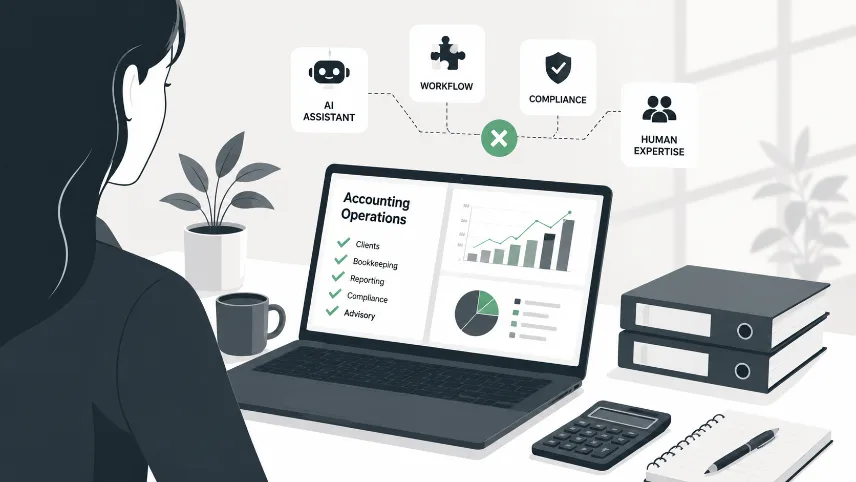
Walk into almost any accounting firm right now and you'll hear the same thing. Someone's testing an AI assistant to draft client emails. Someone else is using it to summarize a tax document in seconds instead of reading the whole thing. It's everywhere, and honestly, it's earned its spot.
But here's the thing a lot of firms are getting wrong. They're treating AI assistants like they're the whole solution to scaling the firm. Like if you just plug in enough AI tools, the growing pains will sort themselves out.
They won't. And it's worth talking about why.
Give Credit Where It's Due
Let's be fair first. AI assistants are genuinely useful for a lot of the small, everyday friction points at a firm.
They're great at drafting a first version of a client email so you're not starting from a blank page. They can summarize a long document in a fraction of the time it would take to read it yourself. They speed up research when you need a quick answer on a tax question or a regulation update. They save real time, task by task.
None of that is in question. The problem isn't that AI assistants are bad. It's that firms are asking them to do a job they were never built for.
Where AI Assistants Hit a Wall
An AI assistant answers the question you ask it, right when you ask it. That's the whole model. You prompt it, it responds. But running a growing accounting firm isn't a series of one-off questions. It's an ongoing operation with a lot of moving parts, and that's where the wall shows up.
AI assistants generally don't:
- Manage workflows across an entire team
- Track deadlines across dozens or hundreds of clients at once
- Handle task assignment or tell you who's overloaded and who has room to take on more
- Give you a clear picture of how the whole firm is doing at a glance
- Follow up automatically when a client hasn't sent something they promised
You can ask an AI assistant to draft a reminder email. You still need something else to know that reminder needs to go out, to whom, and by when, across every single client on your roster.
What Scaling a Firm Actually Requires
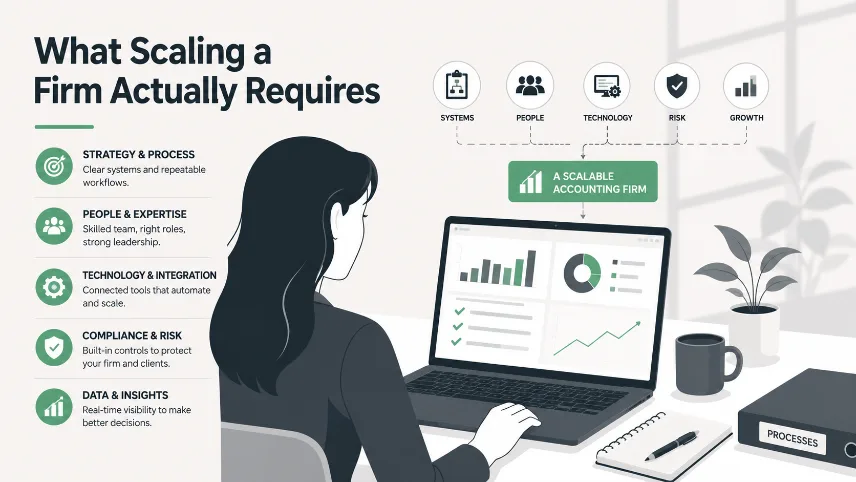
Scaling isn't really about working faster on individual tasks. It's about what happens when your firm goes from 20 clients to 60, or from three people to ten, and things stop fitting in your head.
At that point, a firm needs a few things that no AI assistant is designed to provide:
Consistent workflows everyone follows. Not "ask Sarah, she knows how we do it," but a process that's the same no matter who's doing the work.
Real visibility into deadlines and capacity. You need to know who's behind, who has room, and where the bottlenecks are before they turn into missed deadlines.
Accountability without micromanaging. A system that shows a partner what's happening across the firm without them having to check in on every single task.
Client communication that doesn't rely on memory. Document requests and follow ups that happen on schedule, not when someone remembers to send them.
This is structural stuff. It's not something you can prompt your way into.
Where Practice Management Software Fits In
This is the layer that actually holds a growing firm together. Good accounting practice management software gives a firm the workflows, deadline tracking, and visibility that AI assistants simply aren't built to provide, all in one place instead of spread across inboxes and spreadsheets.
AI can absolutely sit inside that layer and make things faster. Plenty of practice management tools now have AI features built directly into the platform to help draft communications or summarize client notes. But the software itself is what gives a firm the structure to grow past a certain size without things falling through the cracks.
Here's the honest version of what happens without it. A firm can have the smartest AI assistant on the market and still hit a wall at 40 clients, because nothing is tracking who's doing what, what's overdue, or where the firm's capacity actually stands. The assistant answers questions. It doesn't run the operation.
AI and Systems Work Better Together
This isn't really an AI versus practice management debate. The firms that scale well tend to use both, not pick one over the other.
AI speeds up the small stuff. Drafting, summarizing, quick research, the day to day friction that used to eat up time. Practice management systems keep the big picture organized. Deadlines, workflows, team capacity, client communication, all the things that need to run smoothly whether or not anyone remembers to think about them that day.
One helps you move faster. The other keeps you from falling apart while you do.
FAQs
Can AI assistants replace practice management software?
No. AI assistants are great at handling one task at a time, like drafting an email or summarizing a document. Practice management software handles the ongoing stuff, like tracking deadlines, workflows, and team capacity across your whole firm. They solve different problems.
Won't adding another system just create more work?
Usually the opposite happens. Right now that work is probably spread across email, spreadsheets, and sticky notes. Practice management software pulls it into one place, so you're not managing five systems just to keep track of one firm.
How do I know if my firm actually needs more structure instead of more AI tools?
A good sign is if things are still falling through the cracks even though everyone's working hard and using the AI tools you already have. That usually points to a structure problem, not a speed problem.
Conclusion
AI assistants are a great co-pilot. They're not the operating system for your firm, and they were never meant to be. If your firm feels like it's hitting a ceiling even though everyone's working hard and using every AI tool available, the missing piece probably isn't more AI. It's the system underneath that's supposed to hold everything together.
Worth asking yourself honestly: is it actually AI you're missing, or is it structure?