AI directory submission is the process of listing your AI product on curated directories to build backlinks, drive referral traffic, and improve search visibility. For early-stage founders, it's one of the lowest-cost distribution channels available, often delivering the first 20 to 50 referring domains before any outreach campaign begins. AI Directories helps AI startups get listed across hundreds of relevant directories, making the process faster and more predictable from day one.
What AI Directory Submission Actually Costs
Headline number first: expect a range of $0 to roughly $2,000 depending on how much of the work you hand off and how many premium placements you buy. The floor is free DIY submissions; the ceiling is an agency-managed campaign with paid featured slots. Most founders land somewhere in the middle, blending a free tier of broad listings with one or two paid placements on directories that actually send traffic. The AI tools directory ecosystem rewards consistency more than spend.
Free vs. Paid Listings
The majority of directories tracked in the public sergiuchiriac/ai-directories GitHub list accept free basic submissions. Paid placements typically range from $0 to $300 per directory for one-time featured spots, with the price tied to domain authority and monthly traffic. A zero-budget strategy is genuinely viable; you trade money for time. Browse the AI tools categories to see how listings are typically structured before you start filling forms.
Done-For-You Submission Services
Done-for-you services charge a flat fee to distribute across 100+ directories. ListingBott and similar tools sit in the $50 to $200 range for a one-time pass; agencies push toward $500 to $2,000 with manual outreach included. The math is usually favorable: 100 manual submissions at 15 minutes each is 25 hours of founder time, and most founders bill themselves higher than $4 an hour. Compare that against AI tools alternatives to understand the tradeoffs before committing.
Hidden Costs to Budget For
The real cost most founders miss is asset prep: writing descriptions, sizing logos, taking screenshots, and chasing pending approvals. Featured or sponsored slots on high-traffic directories also run $50 to $500 per month as recurring fees, not one-time line items. Budget a half-day for the initial product description and asset kit; that work pays itself back across every directory you touch.
Takeaway: A reasonable founder budget is $0 to $200 for tooling plus four to eight hours of prep, before any premium placements.
The Submission Process: Step by Step
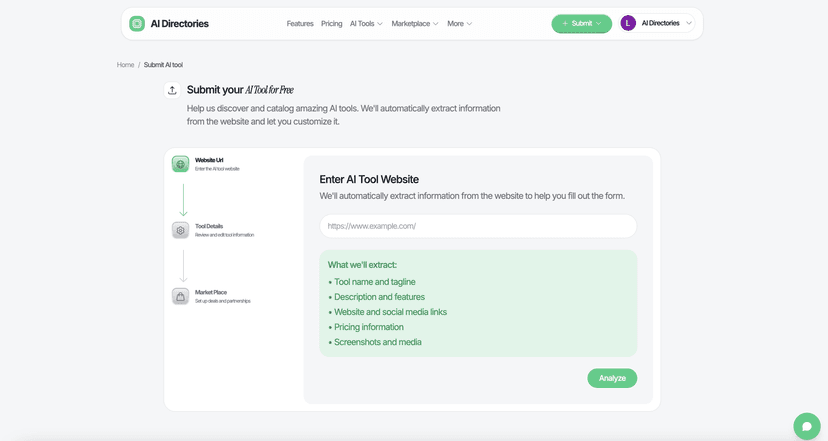
Submission is mechanical once your kit is ready. Skip the kit and every directory becomes a 20-minute slog. Most platforms walk you through four or five form steps and surface the same fields, just in different orders. Building a shared workflow once is the single biggest lever for speed, and it pairs well with a consistent SEO archive routine so listings keep flowing while you ship product.
What You Need Before You Submit
Prepare these assets once, reuse them everywhere:
- Tool name and primary website URL
- Three description lengths: 60 characters, 160 characters, and a 300-word long form
- Logo as a 512x512 PNG with transparent background
- Two or three product screenshots at 1280x720
- Pricing model (free, freemium, paid, open source)
- Category tags and three to five primary keywords
- Founder bio and social profiles
A reusable submission kit cuts per-directory time from 20 minutes to under five. The bio generator is a quick way to draft founder copy if you do not have it locked yet.
Typical Submission Form Fields
Most forms follow a predictable four-step pattern: submitter details, tool information, pricing, and use-case categories, with optional social profiles tacked on. Some directories add a fifth step asking for benefits or differentiators in plain language. The Epirus.vc directory, for example, explicitly asks how you would describe the tool in under two lines, then asks for standout benefits. Tight, specific copy beats clever copy every time, and the same principles apply to your product description workflow.
Review and Approval Timelines
Review windows are all over the map. Fast directories approve within 24 hours. Mid-tier directories take two to four weeks. Lower-priority free submissions sometimes never get a response. Epirus.vc itself notes it receives a "high volume of submissions" and cannot list everything, so completeness and clarity become the deciding factor. Track every submission in a simple log on the blog so you know what is pending, live, or stalled.
Takeaway: A reusable kit plus a tracking sheet turns directory submission from a chore into a 15-minute weekly habit. Pair it with the AI tools tags index to keep your category targeting sharp as you add more directories.
Cost Breakdown by Submission Approach

Here is how the three main paths compare on real cost, time, and output:
| Approach | Out-of-pocket | Founder time | Typical reach | Best for |
|---|---|---|---|---|
| Manual DIY | $0 | 8 to 33 hours | ~100 directories | Pre-revenue founders with more time than budget |
| AI Directories | $199 | ~30 minutes briefing | 100+ curated high-DR directories | Founders who want manual, high-quality submissions without wasting time |
| Automated tools (like ListingBott) | $499+ | 1 to 2 hours | 100 to 500 directories | Solo founders who want maximum automation |
| Agency or freelancer | $200 to $2,000+ | ~30 minutes briefing | 100 to 300 directories with follow-up | Funded teams that want a fully managed process |
Manual is the cheapest line item but the most expensive in real terms once you price founder hours honestly. Automated tools win on cost per directory but produce templated copy that occasionally misses category nuance. Agencies add tracking and outreach but charge for it. The submission approach you pick should match your stage, not your preference.
Reddit threads in the AI tool community report 20 to 50 referring domains within 60 to 90 days when submitting to 100+ directories, with founders generally rating automated tools as positive ROI provided the directory list is curated. Cost per backlink via directory submission typically lands well under outreach-based link building, which averages $150 to $500 per acquired link. For early-stage AI startups, that ratio is hard to beat, and it pairs naturally with broader AI tools listings work.
Takeaway: If your time is worth more than $10 an hour, a $100 automated tool beats manual every time.
What to Expect After You Submit

Directory submissions are a slow compounder, not a traffic firehose. Set expectations now and you will not abandon the strategy at week four. The blog archive has longer reads on realistic timelines if you want to calibrate before you spend a dollar.
Traffic and SEO Impact Timeline
Domain rating uplift from directory backlinks is gradual. Expect measurable DR movement within 60 to 120 days of a broad campaign of 100+ submissions, assuming the directories are real and indexed. Referral traffic from any single directory is usually single digits per month, but aggregate traffic across 100 listings compounds into a meaningful baseline. The main blog index has case studies tracking this curve across different niches.
What Most Directories Actually Deliver
Not every directory backlink is dofollow. Many high-DA directories use nofollow or sponsored attributes, which still provide brand exposure but less direct SEO weight. Listing accuracy also degrades; pricing changes, features ship, logos get refreshed, and the profile you submitted in January is wrong by June. Audit your live listings every three to six months. Directories with active user communities and ratings drive warmer leads than passive listing-only sites, even when the raw traffic numbers look similar. The AI tools deals page is a good example of how a community layer changes conversion behavior.
Takeaway: Treat directory submission as a 90-day campaign with quarterly audits, not a one-and-done task.
Red Flags: When Low Prices Are Too Good to Be True
Cheap submission services are where founders torch budget and occasionally hurt their domain. Watch for these patterns before paying anyone, and route any suspect inventory back to your affiliate partners page before you commit.
- Services promising "1,000+ directories overnight" are almost always blasting to low-quality directories that can trigger Google spam signals.
- One-time fees under $20 for "unlimited" submissions indicate automated mass-posting to directories with near-zero domain authority.
- Vendors that will not share their directory inventory openly are hiding the list for a reason. Legitimate services publish what you are paying for.
- Directories with no editorial review, visible spam listings, or broken category pages provide minimal SEO value and may associate your brand with low-quality content.
- Paid featured slots on directories with less than DA 20 and under 1,000 monthly visitors rarely justify the cost on either traffic or SEO grounds.
A clean rule of thumb: if a service cannot answer "what are the top 10 directories you submit to?" in plain language, walk away. Cross-reference any vendor's claimed list against the AI tools partners directory and the public GitHub list before you pay.
Takeaway: Quality of inventory beats quantity. Fifty real directories outperform 1,000 spam farms every time.
Frequently Asked Questions
How much does it cost to submit an AI tool to directories?
Costs range from $0 for free DIY submissions to $2,000+ for full-service agency campaigns. Most founders spend $50 to $200 on an automated tool plus four to eight hours of prep time on assets and descriptions.
How long does AI directory submission take to show SEO results?
Expect measurable Domain Rating movement anywhere from 7 days to 6 months after a 100+ directory campaign, depending on how fast directories approve and index your listings. Referral traffic can start appearing within the first few weeks and compounds gradually as more listings go live across the portfolio.
Are AI directory backlinks dofollow or nofollow?
Both, with no consistent pattern. Many high-DA directories use nofollow or sponsored attributes by default, while smaller niche directories more often pass dofollow links. A healthy backlink profile naturally includes both types, so do not over-optimize for dofollow only.
What information do I need to submit my AI tool to directories?
Prepare a tool name, website URL, three description lengths (60, 160, and 300+ words), a 512x512 PNG logo, two or three screenshots, pricing model, category tags, and founder social profiles. Build the kit once and reuse it everywhere.
Is it worth paying for a done-for-you directory submission service?
For most solo founders, yes. A $200 automated service covering 100+ directories saves 30+ hours versus manual submission. Agencies make sense when you also need outreach follow-up, live-listing tracking, and quarterly audits handled.
How many AI directories should I submit my tool to?
Aim for 80 to 150 quality directories in the first campaign. Beyond that, you hit diminishing returns and start scraping low-authority sites that add little SEO value. Curate inventory by domain rating and editorial review process.
Can directory submissions hurt my SEO if done incorrectly?
Yes, if you blast to spammy, unreviewed directories at scale. Google can flag patterns of low-quality inbound links. Stick to directories with editorial review, real traffic, and clear category structures to stay on the safe side.
How long does it take for a directory submission to get approved?
Approval windows range from 24 hours to six months depending on the directory. Premium placements review fastest; free submissions to popular directories often take the longest, and some never respond at all. Track every submission to know what is pending.
Conclusion
Directory submission is one of the few distribution channels where a $0 budget and a $2,000 budget can both produce real results, provided you bring a clean asset kit, a curated directory list, and quarterly audits. Skip the spam farms, build the kit once, and treat it as a 90-day compounding play rather than a launch-week stunt. When you are ready to move faster than manual forms allow, the platform handles the distribution across hundreds of vetted directories so you can stay focused on shipping product.