Think about the last time you bought software. You probably did not just click the first Google result. Maybe you searched Google, watched a couple of reviews, skimmed a Reddit thread, then asked ChatGPT or Perplexity something like "What's the best tool for X if I'm a small team on a budget?" Only after all that did you open a tab and sign up.
Your buyers do the same. Research now spans search engines, social platforms, and AI assistants, and the AI step often comes right before the decision. If your product is not in that answer, you miss the moment buyers are shortlisting.
Getting cited by AI answer engines is not magic. This guide covers what Generative Engine Optimization (GEO) is, why it works best alongside SEO, and eight practical steps you can start this week.
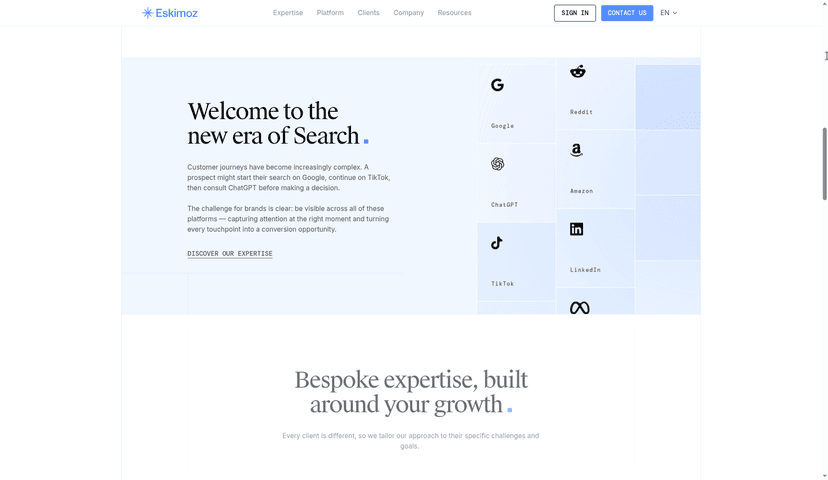
Search no longer stops at Google. Buyers also ask ChatGPT, scroll TikTok, and read Reddit before they decide.
What GEO is and how it differs from SEO
Generative Engine Optimization (GEO) is the practice of making your brand, product, and content easy for AI systems like ChatGPT, Perplexity, Google's AI Overviews, Gemini, and Claude to find, understand, trust, and cite when they generate answers.
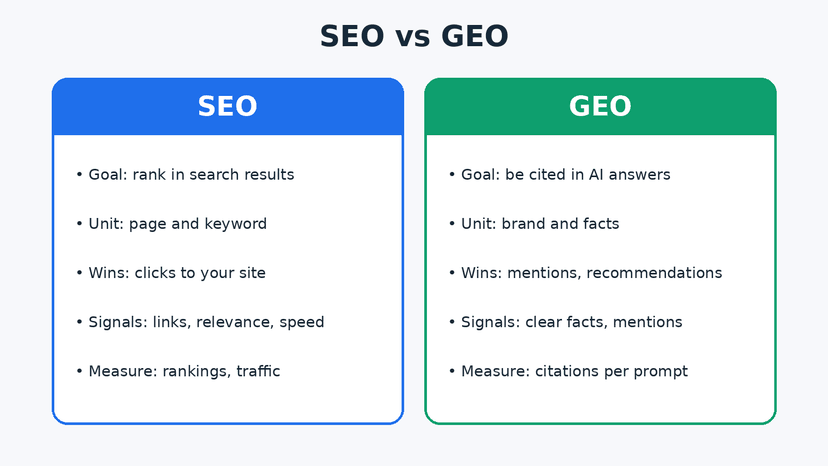
SEO and GEO share the same foundations. The target is different: a ranked page versus a citation inside an answer.
Classic SEO and GEO share a lot, but the goal is framed differently:
- SEO aims to rank a page in a list of results so a person clicks through. If you are still building that base, start with an effective SEO strategy for AI tools.
- GEO aims to have your brand mentioned, recommended, or linked inside a synthesized answer, often with no list of ten blue links at all.
That shift changes a few things in practice:
- The unit of competition is the answer, not the page. An AI tool might pull one sentence from your docs, one from a review site, and one from a Reddit comment, then blend them into a recommendation.
- Being understood matters as much as being found. Vague positioning gets lost.
- Off-site signals carry a lot of weight. What other credible sources say about you often shapes AI answers as much as what you say about yourself. That is the same reason quality backlinks still matter.
- Visibility is harder to measure. There is no single rank position in an AI answer.
Why SEO and GEO reinforce each other
It is tempting to treat GEO as a replacement for SEO. That would be a mistake. Many AI answer engines retrieve live web content to ground their responses, and they lean on the same signals search engines have rewarded for years: crawlable pages, clear structure, topical authority, and trustworthy sources.
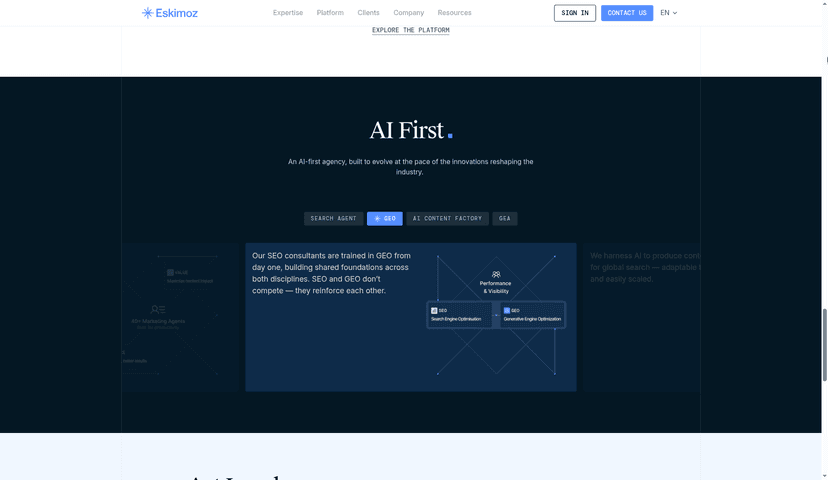
The useful frame: SEO and GEO are one visibility system, not two competing projects.
The team at Eskimoz, an AI-first search agency, puts it simply: SEO and GEO don't compete, they reinforce each other. A technically sound, well-structured site with genuine authority is exactly the kind of source AI tools like to cite. The work you do for GEO, such as clearer answers, better structured data, and stronger third-party coverage, tends to lift organic search too.
Think of GEO as extending your SEO foundations into a world where the result is a conversation.
8 practical steps to get cited by ChatGPT and Perplexity
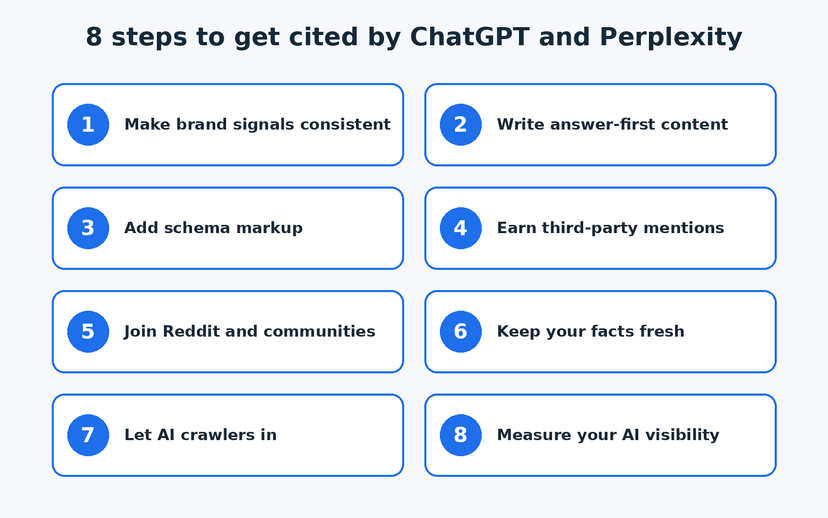
1. Make your entity and brand signals consistent
AI systems build an understanding of your brand from everything they can find. If your homepage calls you "an AI workflow platform," your LinkedIn says "a no-code automation tool," and your directory listings say "a productivity app," you are making their job harder.
- Write one clear, factual description of your product: what it is, who it is for, and the main problem it solves. Keep a short version (one sentence) and a longer version (two or three sentences).
- Use that description consistently on your website, social profiles, app stores, directory listings, press kit, and founder bios.
2. Write answer-first, structured content
AI tools favour content that answers a question directly and can be lifted cleanly into a response.
- Start key pages and articles with a direct answer in the first sentence or two, then expand.
- Use headings that mirror real questions, such as "How much does [Product] cost?"
- Add FAQ sections to product, pricing, and use-case pages, with real questions from sales calls, support tickets, and community threads.
- Create honest comparison and alternatives pages. People constantly ask AI assistants "X vs Y" questions.
3. Add schema markup
Structured data helps machines understand a page without guessing. It is not a guaranteed ticket into AI answers, but it removes ambiguity and is standard good practice anyway.
Useful types for most product companies include:
- Organization (name, logo, URL, and social profiles via
sameAs) - Product or SoftwareApplication (name, category, offers, operating system)
- FAQPage for genuine FAQ sections
- Article with author information for blog content
Validate it with Google's Rich Results Test or the Schema.org validator, and keep it consistent with what is visible on the page.
4. Earn third-party mentions: directories, review sites, and press
When an AI assistant recommends tools, it frequently draws on sources other than your own site. Being described consistently by credible third parties is one of the strongest signals you can build. A higher domain authority makes those mentions easier to earn and easier for machines to trust.
- AI and software directories. Listing your product in reputable, well-maintained directories gives both people and machines another consistent description of what you do. Start with a short list of free directories or the top high-traffic AI directories. Choose curated directories with real editorial standards over low-quality link farms, and reuse the same product description everywhere.
- Review platforms. Encourage happy customers to leave honest reviews on the platforms your buyers actually use.
- Press and expert roundups. Pitch genuinely useful stories or opinions to relevant publications, newsletters, and podcasts.
One mention is not much. A consistent pattern across many trustworthy sources is.
5. Be present on Reddit and in communities
Reddit, niche forums, Discord servers, Slack groups, and Q&A sites are full of the exact questions people later ask AI assistants. Some AI tools surface community discussions directly, and these conversations shape how a product is perceived. If you are choosing where to show up, this list of AI subreddits is a practical starting point.
- Join the communities your buyers use and contribute before you ever mention your product.
- When your product is a genuine fit for a question, say so transparently and disclose that you work on it.
- Never use fake accounts or astroturfing. Communities notice, moderators remove it, and it damages trust far more than it helps.
6. Keep your facts fresh
Outdated information is a common reason AI answers get a product wrong. If your pricing page or directory listing describes last year's product, that is what may get repeated.
- Review your core pages (homepage, pricing, features, About, FAQ) on a regular schedule, for example quarterly.
- Update your directory listings and review-site profiles whenever you change pricing, launch a major feature, or rebrand.
7. Let AI crawlers in: check your robots.txt
You cannot be cited from content an AI system cannot read. Many sites block AI crawlers by accident, through an old robots.txt rule, a plugin, or a CDN setting.

Open yourdomain.com/robots.txt and look for rules that block AI crawlers.
- Check what is allowed and disallowed.
- Know the main user agents. OpenAI uses OAI-SearchBot for ChatGPT search and GPTBot for model training. Perplexity uses PerplexityBot. Google uses Google-Extended as a control for Gemini training, separate from regular Googlebot. Check each provider's documentation, because names and behaviour change.
- Decide deliberately. You might allow search and answer crawlers while blocking training crawlers, or allow both. The key is that it is a choice, not an accident.
- Check your CDN or hosting provider. Some offer one-click or default AI bot blocking that overrides what you think robots.txt is doing.
8. Measure your AI visibility
AI visibility tracking is still an emerging area, but a simple manual process goes a long way.
- Build a prompt list. Write 20 to 50 questions your buyers might ask, such as "best [category] tools for startups," "[your brand] vs [competitor]," or "how do I solve [problem]."
- Test regularly. Run them in ChatGPT, Perplexity, Gemini, and Google's AI Overviews, ideally monthly. Note whether you are mentioned, how you are described, and which sources are cited.
- Track citations. Perplexity and ChatGPT search often show their sources. Those sources tell you which sites to earn coverage from, or which of your own pages to improve.
- Watch referral traffic. In your analytics, look for visits referred by AI tools such as chatgpt.com and perplexity.ai.
Dedicated tracking tools are maturing quickly, but a spreadsheet and a consistent routine are a fine start.
When to bring in an agency
Most of the steps above are doable in-house. Outside help makes sense when you compete in a crowded category, manage several markets or languages, juggle paid and organic channels, or lack the time to run a consistent programme.
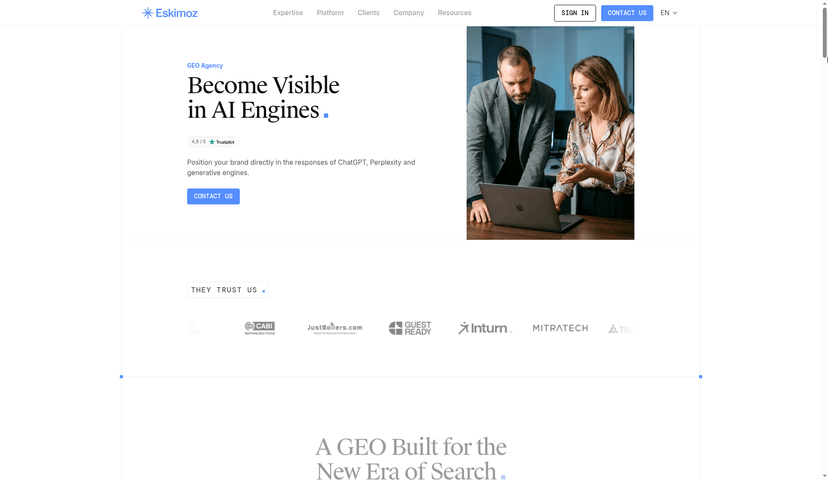
If you get there, look for a partner that treats SEO and GEO as one connected discipline rather than selling GEO as a standalone novelty. Eskimoz is one example of that approach. It describes itself as an AI-first search agency, with services spanning SEO, GEO, SEA/PPC, social, Amazon, CRO, and a content factory, and offices in London, Paris, Milan, Madrid, and Düsseldorf. The agency says it is trusted by more than 2,200 organisations, and its SEO consultants are trained in GEO from day one. It also uses AI agents to automate SEO tasks such as content production and competitive analysis, alongside a proprietary client interface that centralises acquisition data. On the paid side, it is a Google Premier Partner for paid search and has been early on generative engine advertising (GEA).
One example from its client work: fashion brand Sandro saw a +475% increase in keywords ranking in the top 1 to 3 positions and +150% global organic traffic. Esther Beaumont, Digital and E-commerce Director at Sandro, described the experience as "Excellent support and agency! Close, hands-on follow-up, real professionalism, expertise, and commitment on the topics."
Whoever you work with, ask how they measure AI visibility and connect it to revenue. If you want to see how an integrated approach looks in practice, you can explore Eskimoz's SEO and GEO services.
FAQ
Is GEO replacing SEO?
No. AI answer engines often rely on web content that is crawlable, well-structured, and authoritative, which is exactly what good SEO builds. GEO extends SEO into AI-generated answers rather than replacing it.
How long does it take to get cited by ChatGPT or Perplexity?
There is no fixed timeline. Tools that search the web live, such as Perplexity and ChatGPT search, can reflect updated content fairly quickly once it is crawled. Changes in what models learned from training data take longer.
Do AI directory listings help with GEO?
They can be one helpful signal among many. A listing on a reputable, curated directory gives AI systems and people another consistent, third-party description of your product. It works best as part of a broader mix, not as a shortcut.
Should I block GPTBot and other AI crawlers?
It depends on your goals. Blocking search-focused crawlers like OAI-SearchBot or PerplexityBot can reduce your chances of being cited in those tools. Some brands allow search crawlers while blocking training crawlers. Just make it a deliberate decision.
Can I pay to appear in ChatGPT or Perplexity answers?
You cannot buy a placement in organic AI answers. Advertising inside AI experiences is emerging, which is why some agencies are exploring generative engine advertising, but earned citations still rest on clear content, technical accessibility, and a strong reputation.
Conclusion
Your buyers are asking AI assistants for recommendations right now, often at the very moment they are building a shortlist. Getting into those answers comes down to fundamentals: be clear and consistent about who you are, answer real questions, make your site easy for machines to read, earn genuine third-party mentions, keep your facts current, and measure what AI tools say about you.
None of this requires abandoning what already works. SEO and GEO reinforce each other. Start with one or two steps, such as fixing your product description everywhere and checking your robots.txt, then build from there. The brands that show up consistently and helpfully across the web are the ones AI answers keep coming back to.