Introduction
Imagine losing 999 out of 1,000 users without ever knowing why. That’s the brutal truth about app feedback in 2025. Most developers rely on emails, portals, or App Store reviews, but those channels rarely capture meaningful insights. Users either ignore them or leave vague, unhelpful comments.
FeedbackWall changes that. It’s a lightweight Swift SDK designed to ask users directly inside your app. No more guessing what went wrong or waiting weeks for reviews to trickle in. With FeedbackWall, you can capture feedback in real time, right when it matters most.
The tool was born out of frustration indie developers and product managers were tired of building features in the dark. By embedding surveys seamlessly into the app experience, FeedbackWall makes feedback collection fast, flexible, and engaging. And because surveys can be updated without App Store resubmissions, you stay agile while keeping users heard.
What is FeedbackWall?
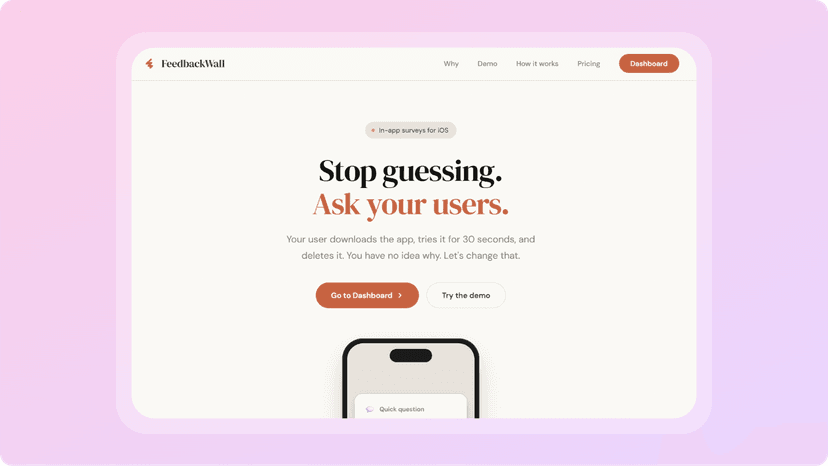
FeedbackWall is an in app survey SDK for iOS that makes feedback collection seamless. By embedding surveys directly into the app experience, it eliminates the friction of external channels. Users don’t have to leave the app, open an email, or log into a portal; they simply respond in the moment. This immediacy is what drives response rates far higher than traditional methods.
Unlike email campaigns or review requests, FeedbackWall feels natural. It’s contextual, triggered by specific events, and designed to blend into the app’s interface. Developers, product managers, and indie creators benefit from actionable insights without disrupting the user journey.
The result is feedback that’s both richer and more reliable.
- How it differs: Unlike email blasts or portals, FeedbackWall doesn’t interrupt the user’s flow. It’s contextual, timely, and far more effective than waiting for reviews.
- Target audience: Developers, product managers, and indie creators who want actionable insights without heavy infrastructure.
- Core value: Higher response rates typically 15 to 25% compared to the 1 to 2% you’d get from emails. That’s a massive difference in understanding what users actually want.
The History of App Feedback Challenges
For years, app teams relied on outdated methods like email surveys and support portals. The problem was clear: users rarely engaged. Response rates hovered around 1 to 2%, and the feedback that did come in was often vague or irrelevant. Reviews on the App Store didn’t help much either; they were public, hard to interpret, and usually skewed toward extremes.
The rise of in app surveys changed the game. By meeting users where they already are, developers could finally capture feedback in context. FeedbackWall emerged during this shift, quickly gaining traction among indie developers who needed lightweight solutions. Its recognition on Product Hunt highlighted the growing demand for smarter, more integrated feedback tools.
How FeedbackWall Works
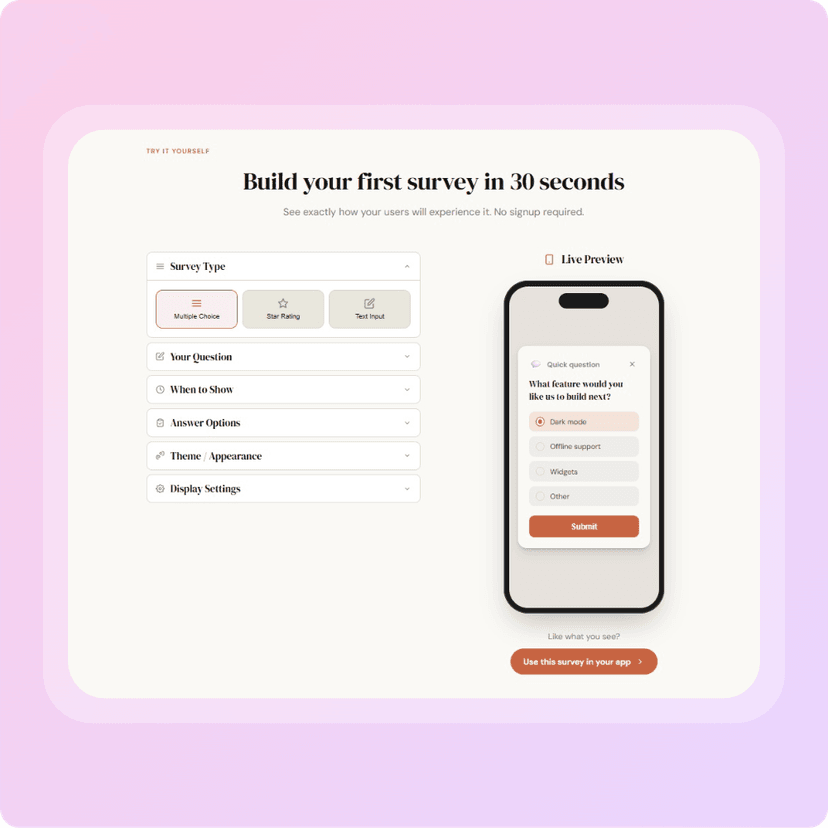
Integrating FeedbackWall is refreshingly simple. With just a few lines of Swift code, developers can embed surveys into their apps in under five minutes. Once installed, the dashboard gives full control over targeting, segmentation, and survey design. This means you can tailor questions to specific user groups without touching the code again.
The real magic lies in its flexibility. Surveys can be updated instantly without requiring App Store resubmissions. You can trigger them during onboarding, after a feature is used, or when a user goes inactive.
This ensures feedback is collected at the right time, making it far more actionable than generic surveys.
- Dashboard control: You can segment users, target specific groups, and manage surveys without touching code.
- Real time updates: Surveys can be changed instantly no App Store review required.
- Example triggers: Onboarding flows, feature launches, or periods of inactivity.
Each trigger ensures feedback is collected at the right moment. This setup means you’re not just collecting random opinions; you're gathering insights tied directly to user behavior.
Key Features of FeedbackWall
FeedbackWall offers a wide range of question types, multiple choice, ratings, and open text so you can capture both quantitative and qualitative insights. This variety helps developers understand not just what users think, but why they feel that way.
Beyond questions, the SDK supports event based triggers and recurring surveys. You can customize the design to match your app’s UI, ensuring a seamless experience. Real time analytics in the dashboard provide immediate visibility into responses, helping teams act quickly on emerging trends.
- Multiple question types: From multiple choice to ratings and open text, you can tailor surveys to your needs.
- Event based triggers: Surveys can appear after specific actions, like finishing onboarding or using a new feature.
- Customizable design: Match your app’s UI so surveys feel native, not intrusive.
- Real time analytics: A dashboard shows responses as they come in, helping you act quickly.
Pricing and Plans
FeedbackWall’s pricing is designed to grow with you. The Indie plan at $19/month covers up to 200 responses, perfect for small projects or early stage apps. The Growth plan at $49/month expands to 1,000 responses, while the Scale plan at $99/month supports 5,000 responses for larger teams.
| Plan | Price | Responses Included | Notes |
|---|---|---|---|
| Indie | $19/month | Up to 200 | Perfect for small projects or early stage apps |
| Growth | $49/month | 1,000 | Designed for expanding projects |
| Scale | $99/month | 5,000 | Supports larger teams |
| Free trial | $0 | Limited testing |
Use Cases for iOS Developers
Onboarding surveys are a great way to capture user intent early. By asking why someone downloaded your app or what they hope to achieve, you can tailor the experience to meet their needs. This reduces churn and builds stronger engagement from day one.
Feature validation is another powerful use case. After releasing a new feature, you can ask users directly if it meets expectations. Inactivity surveys help identify why users stop engaging, while quarterly roadmap surveys provide input for prioritizing development.
- Onboarding surveys: Capture user intent early.
- Feature validation: Ask users if a new release meets expectations.
- Churn reduction: Trigger surveys when users go inactive.
- Roadmap prioritization: Collect quarterly insights to guide development.
These use cases help developers move from assumptions to evidence based decisions.
Benefits for Product Managers
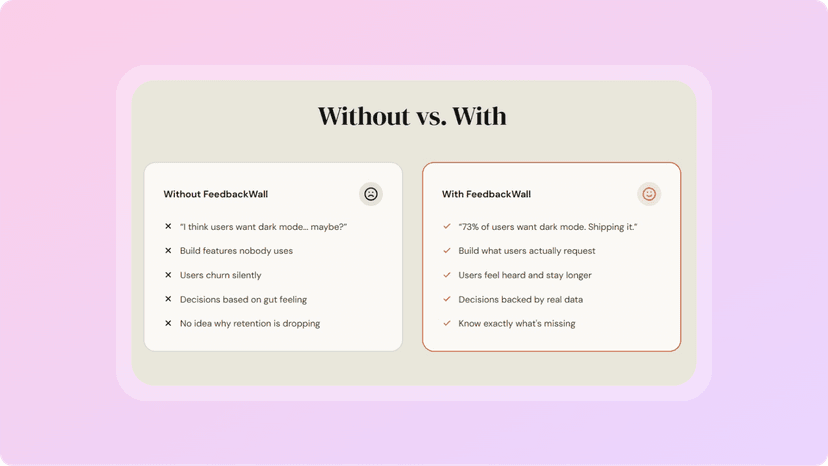
Product managers often face the challenge of prioritizing features with limited data. FeedbackWall provides clarity by turning user opinions into actionable insights.
Instead of guessing, PMs can rely on real feedback to guide decisions. FeedbackWall provides clarity:
- Data driven decisions: No more guessing which features matter.
- Retention boost: Users feel heard, which increases satisfaction.
- Revenue unlocks: Prioritize features that drive engagement and monetization.
Example: When users demanded dark mode, FeedbackWall surveys captured the trend early, helping teams deliver faster.
Future Roadmap and Platform Expansion
Currently, FeedbackWall supports Swift/iOS, but expansion is on the horizon. React Native, Android, and Flutter are next in line, opening the door for cross platform teams to benefit from the same seamless feedback collection.
Community voting plays a role in shaping this roadmap. Developers can influence which platforms are prioritized, ensuring FeedbackWall evolves with real demand. For teams managing multiple stacks, this expansion means unified feedback across all platforms.
- Upcoming platforms: React Native, Android, and Flutter.
- Community voting: Developers can influence which platforms come next.
- Cross platform implications: Teams managing multiple stacks will benefit from unified feedback collection.
Conclusion
FeedbackWall isn’t just another SDK it’s a turning point in how app creators listen to users. Traditional feedback channels failed, leaving developers blind to churn. FeedbackWall fixes that by embedding surveys directly into the app experience.
For iOS developers, product managers, and indie creators, adopting FeedbackWall means fewer guesses, more retention, and smarter product decisions. You’re not just collecting feedback you’re building with confidence.