
Generative engine optimization (GEO) is the practice of structuring digital content so AI-powered search and answer engines, such as ChatGPT, Perplexity, and Google's AI Overviews, can accurately retrieve, summarize, and cite it in their responses. As AI-driven discovery reshapes how users find information, GEO has become a core part of any modern visibility strategy. AI Directories tracks the tools and tactics that help content teams stay visible in this new landscape.
Definition
GEO stands for generative engine optimization. It covers the editorial and technical work needed to make a page legible to large language models so they can pull facts, sentences, and citations into AI-generated answers. The goal is not just a blue-link ranking. The goal is being quoted inside the answer itself.
What GEO Means in Plain English
Think of GEO as writing for two readers at once: the human scanning the page and the language model summarizing it. The human wants a clear takeaway. The model wants structured facts, named sources, and unambiguous phrasing it can lift into a response. Founders running an autopilot SEO workflow treat GEO as a layer on top of existing publishing, not a replacement for it.
In plain English: write the answer first, then the explanation, and make every claim something a model could repeat with confidence.
Related Terms You May Encounter
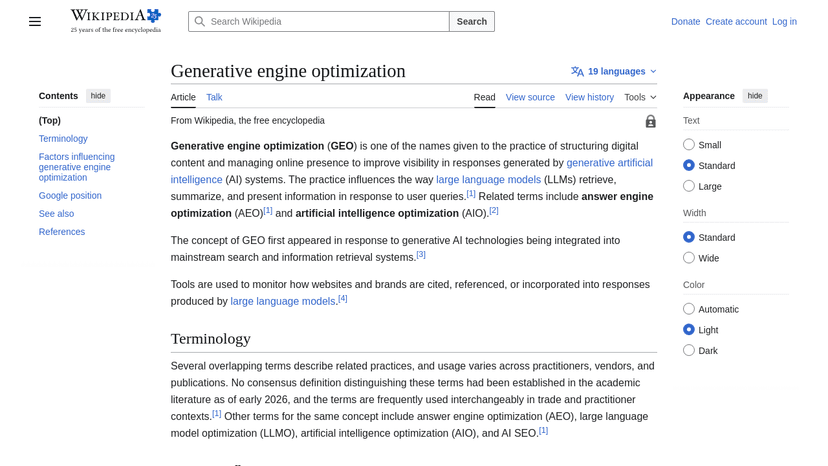
Practitioners use several names for the same discipline. According to Wikipedia's GEO entry, related terms include answer engine optimization (AEO), large language model optimization (LLMO), artificial intelligence optimization (AIO), and AI SEO. No academic consensus distinguishes them as of early 2026, so expect the vocabulary to keep moving. Google's 2026 documentation states that "optimizing for generative AI search is optimizing for the search experience, and thus still SEO." If you already maintain a content backlog inside an AI tools directory, most of that work still counts.
Takeaway: pick one term and stick to it internally, but recognize the others when vendors pitch you.
How GEO Works

LLMs do not browse like humans. They evaluate candidate sources for semantic relevance, structural clarity, and authoritativeness, then decide which passages to summarize or cite. Understanding that selection logic is the whole game. Reviewing AI tool categories can help you identify which content types are already structured for this kind of retrieval.
How LLMs Select and Cite Sources
When a user asks Perplexity or ChatGPT a question, the system retrieves a set of candidate pages, scores them, and stitches together an answer with citations. Pages that score well tend to have direct question-and-answer phrasing, clean heading hierarchy, and verifiable facts the model can attribute. Founders building backlinks through manual directory submissions already understand the trust equation: the more credible signals point at a page, the more likely it gets pulled into an answer.
By early 2026, GEO practitioners shifted focus from keyword placement to semantic relevance, partly driven by the integration of advertising into conversational AI platforms. The mechanics changed. The principles, write clearly, cite sources, earn references, did not.
Semantic Relevance and Trust Signals
Trust signals matter as much as structure. Clear authorship, publication dates, named citations, and verifiable data all increase the odds an AI engine treats a page as reliable. According to Coursera's analysis of the AI Overview shift, webpages experience a 34.5 percent lower average click-through rate when an AI Overview appears nearby, which makes direct citation inside the answer a critical visibility channel rather than a bonus. Pairing strong on-page signals with dofollow backlinks from credible sources reinforces the authority cues LLMs evaluate.
Takeaway: structure earns the retrieval, trust signals earn the citation.
GEO vs Traditional SEO
The two disciplines share more than they diverge, but the divergence is where strategy gets interesting.
Where the Two Disciplines Overlap
Both reward clear, well-structured content, authoritative sourcing, and topic depth. A page that loads quickly, has logical headings, cites primary research, and earns external references will perform well in both ranked search results and AI-generated answers. Teams already shipping a monthly SEO process usually have most of the foundation in place.
Where They Diverge
Traditional SEO uses backlinks, keyword density, and user behavior signals to push pages higher in ranked results. GEO focuses on whether an AI engine incorporates and cites your content inside its generated answer. Coursera notes that GEO prioritizes factual, extractable content that AI engines can summarize, while SEO still heavily weights link equity and on-page keyword signals. The recommended starting point is to combine the two: keep improving index ranking through SEO while optimizing structure and authority signals for AI citation, with platforms like the AI Directories blog tracking which tactics actually move the needle.
| Dimension | Traditional SEO | GEO |
|---|---|---|
| Primary goal | Higher SERP rank | Inclusion in AI answer |
| Main signals | Backlinks, keywords, CTR | Structure, citations, semantic clarity |
| Format preference | Long-form, keyword-rich | Direct Q&A, scannable |
| Success metric | Organic clicks | Brand mentions in AI responses |
Takeaway: GEO is an extension of SEO, not a replacement, and the smart play is to run them together.
Core GEO Techniques
A handful of editorial moves do most of the heavy lifting. None of them require new tooling, just discipline.
Structuring Content for AI Readability
A logical heading hierarchy, H1 for the main topic, H2 and H3 for sub-questions, helps LLMs parse structure and meaning without ambiguity. Bullet lists, comparison tables, and summary boxes make extraction easier. Schema markup and structured data reinforce machine-readable context, helping AI platforms identify the type, subject, and credibility of a page. Founders auditing their existing AI tool listings can usually fix structure issues in a single editing pass.
Building Authority and Trust
Expert quotes, named statistics with cited sources, and clear publication dates all signal authenticity. The 2024 Princeton research on GEO referenced across practitioner communities found that citation-heavy content earned noticeably higher inclusion rates in AI responses. External references work the same way they do for traditional SEO: a page cited by credible sources gets trusted more. Listings in curated directories add another reference layer that AI systems can crawl.
Using Conversational Language and FAQs
Write in a direct, question-and-answer style: answer the question in the first sentence, then elaborate. According to Reply's practical GEO guide, FAQ sections map directly to user prompts, making it easier for LLMs to match content to a query. A dedicated FAQ block at the end of a page, plus inline question-shaped subheadings, doubles your surface area for prompt matching. Tools like an AI bio generator can help draft conversational summary blocks quickly when you are retrofitting older pages.
Takeaway: structure earns the read, conversational phrasing earns the citation.
Common Misconceptions About GEO

Three myths cause most of the wasted effort.
Misconception: GEO Replaces SEO Entirely
Reality: Google's official 2026 documentation explicitly frames GEO as an extension of SEO. Strong traditional signals still influence which pages AI systems draw from. If your domain has no link building foundation, no amount of FAQ formatting will get you cited at scale.
Misconception: Keyword Optimization Is Obsolete
Reality: keyword strategy does not disappear, it shifts. Long-tail, natural-language phrases that mirror conversational queries replace short, high-density terms. Instead of "geo tools free" you write for "what are the best free GEO tools." Teams running a monthly SEO cadence already lean this direction.
Misconception: Any Structured Content Gets Cited
Reality: structure alone does not guarantee citation. Topical authority, external references, and factual accuracy are evaluated alongside formatting. A perfectly formatted page with no citations and no inbound links will lose to a messier page with strong proof points. Vendors selling "AI-ready" templates inside generic tool marketplaces tend to skip this part.
Takeaway: format is the floor, not the ceiling.
How to Get Started With GEO
You can make meaningful progress in a single afternoon if you focus on the right pages.
Immediate Actions You Can Take
- Audit your top ten high-traffic pages for clear H2/H3 structure, direct question-and-answer paragraphs, and verifiable citations.
- Add or expand FAQ sections, framing each question as a natural-language prompt.
- Publish or update content with clear author bylines, publication dates, and outbound links to primary sources.
- Add schema markup where it makes sense, particularly Article and FAQPage types.
- Build inbound references through guest posts, partner pages, and submissions to curated directories.
Salsify's step-by-step GEO guide recommends starting by understanding AI content priorities, then organizing content hierarchically, before layering in authority signals. That order matters: format first, then trust.
Tools for Monitoring AI Visibility
Several monitoring tools now track how often a brand or domain is cited in AI-generated responses from ChatGPT, Perplexity, and Gemini. Pick one and set a baseline before you start optimizing, otherwise you will not know what worked. The growing field of citation-tracking platforms catalogued in the AI Directories tool index gives founders a starting shortlist without the affiliate noise.
Takeaway: audit, fix, measure, repeat. GEO rewards the same operating cadence as good SEO.
Frequently Asked Questions
What is the difference between GEO and SEO?
SEO pushes your page higher in ranked search results using backlinks, keywords, and behavior signals. GEO focuses on whether AI engines incorporate and cite your content inside generated answers. They overlap heavily but optimize for different end states.
Does GEO replace traditional search engine optimization?
No. Google's 2026 documentation explicitly states that optimizing for generative AI search is still SEO. GEO is an extension that adds structure, conversational phrasing, and citation hygiene on top of the traditional ranking foundation you already maintain.
Which AI platforms does GEO target?
GEO targets any generative answer engine that retrieves and cites web sources, including ChatGPT, Perplexity, Google's AI Overviews, Microsoft Copilot, and Gemini. The underlying techniques transfer across platforms because all of them reward clear structure and verifiable sourcing.
How do I know if my content is being cited by AI engines?
Use AI visibility monitoring tools that track brand and domain mentions across ChatGPT, Perplexity, and Gemini responses. Manually testing prompts your audience would actually ask is a fast, free way to spot citation gaps before you commit to a paid tracker.
What content changes have the biggest impact on GEO performance?
Three changes move the needle most: rewriting opening sentences to directly answer the heading, adding FAQ sections that mirror real user prompts, and citing named primary sources with dates. Structural cleanup beats word-count expansion almost every time.
Is GEO relevant for small websites or only large brands?
GEO is arguably more useful for small sites. LLMs reward clarity and citation quality over domain size, so a well-structured niche page can earn citations alongside major publishers. Small teams should prioritize topical depth and trust signals over volume.
What does semantic relevance mean in the context of GEO?
Semantic relevance is how closely a passage matches the meaning, not just the keywords, of a user's question. LLMs evaluate concepts, entities, and relationships between them, so content that fully covers a topic outperforms content that merely repeats target phrases.
How long does it take to see results from generative engine optimization?
Citation appearances can shift within days for low-competition prompts, but durable visibility usually takes one to three months. The lag depends on how often AI systems refresh their indexes and how quickly your trust signals, including backlinks and references, accumulate.
Conclusion
GEO is the natural next layer on top of solid SEO: clearer structure, direct answers, named sources, and trust signals AI systems can verify. None of the moves are exotic. They are the same habits that produced good content before LLMs, applied with sharper discipline. Start with the pages that already get traffic, fix structure first, then layer authority. For ongoing benchmarks, tooling reviews, and tactical breakdowns, the team at the AI Directories blog keeps a running log of what is actually working for founders shipping content this quarter.