
Adverity has built a solid reputation as an enterprise-grade marketing data platform, pulling together fragmented data from ad platforms, CRMs, and analytics tools into one place. But that enterprise positioning comes with trade-offs: a steep learning curve, implementation timelines that can stretch for weeks, and pricing that scales quickly as data volume or connector count grows.

Adverity homepage: an enterprise marketing data platform pitched around data AI can trust.
For marketers who want fast time-to-value without a dedicated data engineering team on standby, it's worth looking at tools built with different priorities in mind: speed of setup, transparent pricing, and, increasingly, built-in AI that does the analysis for you instead of just moving the data.
Below are five of the most relevant alternatives on the market in 2026: Coupler.io, PorterMetrics, Supermetrics, Airbyte, and Fivetran. Each takes a genuinely different approach, so the best one depends on who's using it and what they need the data to do once it lands.
If you compare tools the same way for other parts of a marketing stack, these roundups on AI Directories use a similar side-by-side approach: Product Hunt Alternatives: 15 Launch Platforms in 2026, ElevenLabs Instagram Transcript Generator + 5 Alternatives, and Best Directory Submission Service: 8 Top Picks for 2026.
What to look for in an Adverity alternative
Before comparing tools, it helps to know what actually separates them:
- Who sets it up: does it need an analyst or engineer, or can a marketer configure it solo?
- Where the data lands: spreadsheets and BI dashboards, or a data warehouse?
- How much interpretation it does: does it just move data, or help you understand it?
- Pricing model: flat subscription vs. usage-based (rows, credits, or connector count).
- Who owns and hosts it: a managed cloud product, or infrastructure you run yourself?
Keep these five in mind as you go through the list.
1. Coupler.io — top Adverity alternative for marketers who want AI-powered insights, not just data pipelines
Coupler.io is a no-code data integration and reporting platform built specifically for marketers, agencies, and finance or ops teams who want clean, automated data without writing SQL or waiting on a data team. It's one of the few Adverity alternatives that leans hardest into AI on top of its integrations, rather than treating data movement as the whole product.
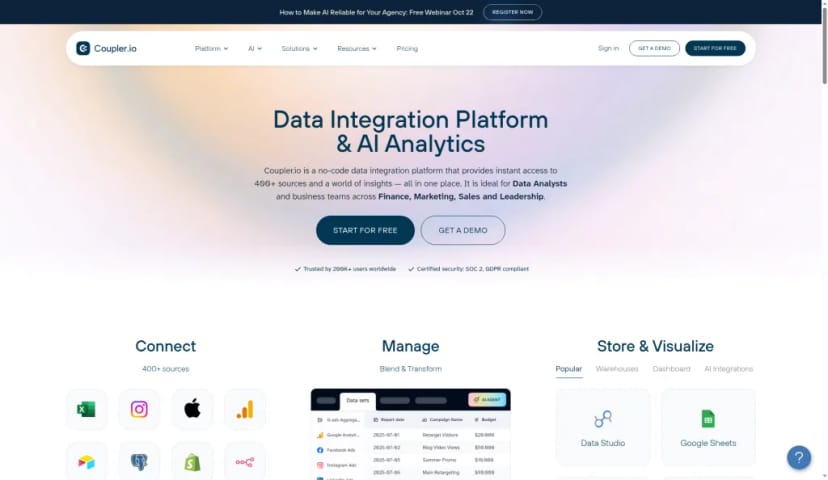
Coupler.io homepage: data integration plus AI analytics, with a free start option.
- 400+ data sources, including Google Ads, Meta Ads, LinkedIn Ads, TikTok, HubSpot, Shopify, and QuickBooks, feeding into Google Sheets, Excel, BigQuery, Looker Studio, or Coupler.io's own Dashboards.
- AI Insights, built directly into Coupler.io Dashboards, reads live marketing data and generates a plain-language summary of trends, anomalies, and benchmark comparisons in under 30 seconds, plus concrete recommendations on what to fix or double down on.
- Coupler AI and Skills let you ask questions of your business data in natural language and save recurring analysis logic as reusable Skills, so a team doesn't have to reconstruct the same prompt every week.
- Native AI integrations with ChatGPT, Claude, Cursor, and Perplexity, plus a Coupler.io MCP Server in active development for querying large datasets via natural language at scale.
- Fast, self-serve setup. Most marketers are live in under an hour, with transparent published pricing instead of a quote-based enterprise sales process.
Compared to Adverity, Coupler.io trades some enterprise-scale data governance for speed, and AI features aimed at people who need answers, not just clean tables, which is exactly why Coupler.io keeps showing up as the top Adverity alternative on shortlists built for marketers rather than data engineers.
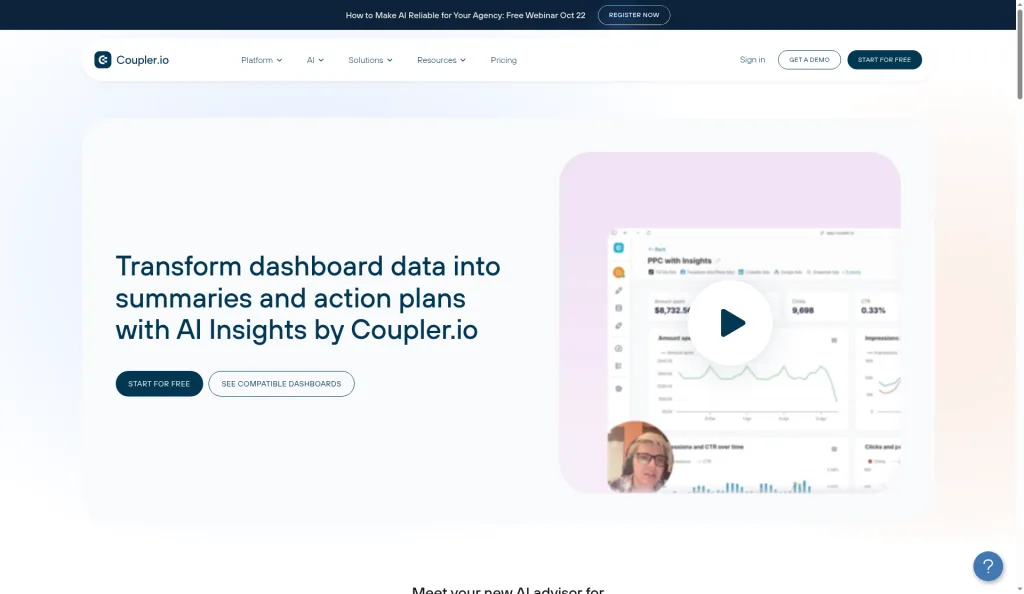
Coupler.io AI Insights turns dashboard data into plain-language summaries and action plans.
Best for: marketing teams and agencies that want a fast, self-serve setup plus AI-assisted reporting, without hiring a dedicated analyst.
2. PorterMetrics
PorterMetrics is a lightweight marketing data connector built around Google Sheets and Looker Studio, aimed at small teams and agencies that want ROI-focused dashboards without a steep learning curve or a large budget.
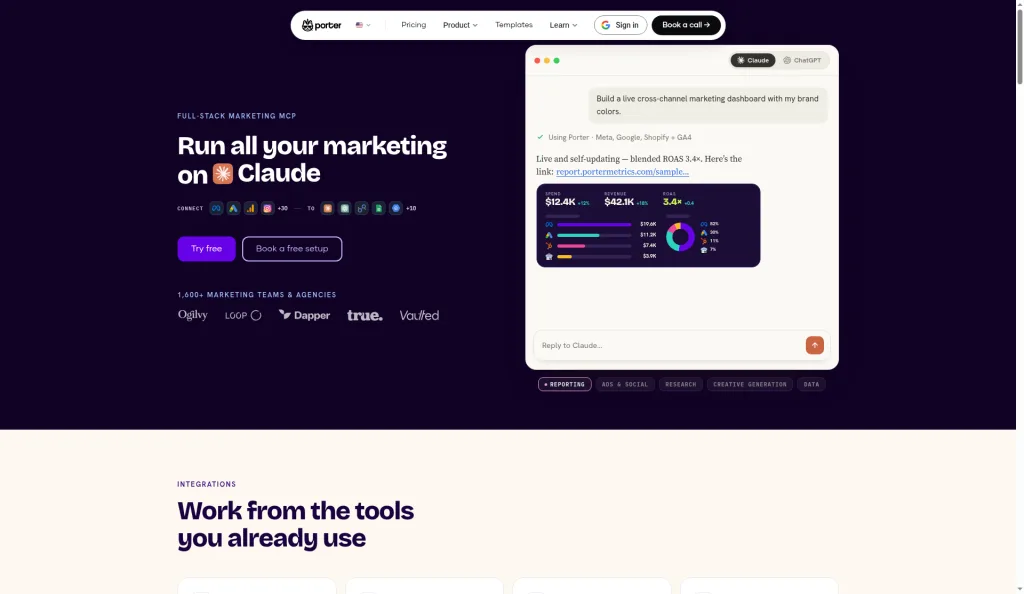
PorterMetrics (now branded Porter) homepage, which currently leads with running marketing reports through Claude.
- Ready-made dashboard templates you can copy and edit, so a first report is often live within an hour of connecting an account.
- Native destinations across Google Sheets, Looker Studio, and BigQuery, all included even on the free plan.
- Flexible data freshness, letting teams choose real-time or stored/cached syncs depending on the report's needs.
- A smaller connector library — around 20–25 sources that cover the core ad platforms and CRMs well but fall short if you need niche or enterprise sources like Salesforce or Oracle.
- Limited advanced transformation and attribution features, so complex, multi-touch reporting will likely need a heavier tool alongside it.
- Budget-friendly pricing, with a free-forever tier and paid plans based on connected accounts rather than data volume.
Best for: small marketing teams and agencies that mainly report through Google Sheets or Looker Studio and don't need deep enterprise connectors.
3. Supermetrics
Supermetrics is the tool most marketers have probably already used in some form. It specializes in pulling data from ad platforms and marketing tools directly into spreadsheets and BI destinations, with a strong focus on the paid media and social reporting use case that made it popular in the first place.

Supermetrics homepage: connect marketing platforms to Supermetrics Studio, Claude, or your reporting tool.
- Fast setup for spreadsheet users — often running within minutes of connecting an ad account, with no separate infrastructure required.
- Deep, well-maintained ad platform connectors for Google Ads, Meta, LinkedIn, and TikTok, which matter most for paid media specialists tracking campaign-level detail.
- Familiar destinations: Google Sheets, Excel, Looker Studio, and BigQuery, so adoption across a team tends to be quick since nobody has to learn a new interface.
- AI-powered summaries have started appearing in recent releases, though the interpretation layer is lighter than platforms built AI-first from the ground up.
- Costs can climb as more data sources or higher refresh frequencies are added.
- Narrower scope for cross-functional reporting — less suited to combining finance, sales, and operations data alongside marketing.
Best for: paid media specialists and marketers who live in spreadsheets and want the fastest possible path from ad account to spreadsheet row.
4. Airbyte
Airbyte is the open-source option on this list, and it appeals to a very different buyer than Coupler.io or PorterMetrics: teams that want full control over their data infrastructure and are comfortable running (or paying someone to run) that infrastructure themselves.
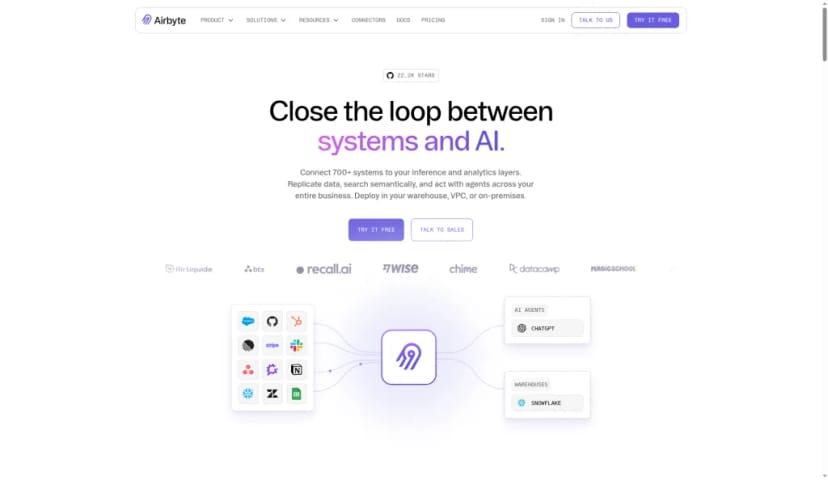
Airbyte homepage, with its open-source GitHub following front and center.
- Open-source and self-hostable, meaning your data never leaves your own cloud environment and there's no vendor lock-in on the platform itself.
- 300+ connectors covering APIs, databases, and data warehouses, with a Connector Development Kit for building custom connectors when a source isn't already covered.
- No volume-based pricing on the self-hosted version, which can make costs far more predictable at scale compared to row- or credit-based competitors.
- Built-in scheduling and orchestration, with the option to layer in Airflow, Prefect, or Dagster for more advanced pipeline management.
- No native dashboards or marketing-specific reporting layer. Airbyte moves and normalizes data; visualizing it is a separate project.
- Meaningful setup and maintenance overhead. Self-hosting Airbyte (or managing Airbyte Cloud configurations) is closer to a data engineering task than something a marketer would do solo.
Best for: organizations with in-house data engineering resources that want an open-source, cost-predictable alternative to volume-priced pipeline tools.
5. Fivetran
Fivetran is one of the most established names in automated data movement, but it comes from a different starting point than Coupler.io. It's built as an ELT (extract, load, transform) pipeline tool for data engineering teams, designed to reliably move large volumes of data into a warehouse rather than to marketers directly.
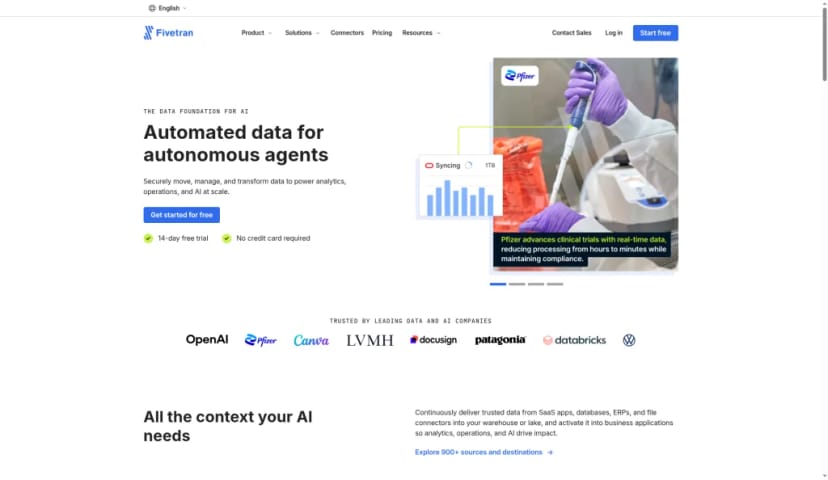
Fivetran homepage: automated data movement positioned as the data foundation for AI.
- Extremely reliable, well-maintained connectors with strong automated handling of schema drift, a common pain point when source APIs change without warning.
- Deep source coverage spanning databases, internal systems, and SaaS applications well beyond marketing, making it a natural fit when marketing data is just one feed among many.
- Built for scale, handling very large data volumes with minimal manual intervention once configured.
- No built-in dashboard or reporting layer. A separate BI tool such as Looker, Tableau, or Power BI is needed to actually see and act on the data.
- Usage-based pricing on Monthly Active Rows (MAR), which can become unpredictable and expensive as marketing data volume grows.
- Technical setup and ownership. Configuration and maintenance are generally handled by a data engineering team rather than marketers, adding a dependency most lean teams would rather avoid.
Best for: organizations that already have a data warehouse and a data engineering function, and treat marketing data as one input feeding a central analytics stack.
Comparison at a Glance
| Best for | Setup | AI features | Destination | |
|---|---|---|---|---|
| Coupler.io | Marketers and agencies wanting fast setup plus AI insights | Self-serve, under an hour | AI Insights, Coupler AI/Skills, MCP Server | Sheets, Excel, BigQuery, native Dashboards |
| PorterMetrics | Small teams reporting via Sheets or Looker Studio | Self-serve, minimal setup | None built-in | Sheets, Looker Studio, BigQuery |
| Supermetrics | Paid media and spreadsheet-first marketers | Self-serve | Emerging AI summaries | Sheets, Excel, Looker Studio |
| Airbyte | Teams with in-house data engineering | Technical, self-hosted or Cloud | None built-in | Warehouses, lakes, databases |
| Fivetran | Data engineering teams | Technical, warehouse-first | Minimal (relies on downstream BI) | Data warehouses |
| Adverity | Large enterprises with dedicated data teams | Implementation phase required | ML-based harmonization | Dashboards, warehouses |
How Much Does "No-Code" Really Change Your Workload?
No-code tools like Coupler.io, PorterMetrics, and Supermetrics remove the need to write pipeline code, but they don't remove the need to understand your data model. Someone still has to decide which metrics matter, how to reconcile numbers across platforms, and what a spike or dip actually means. The real difference between these tools is how much of that second layer they help with — which is where Coupler.io's AI Insights and Skills start doing work a marketer used to have to do manually every week.
Does Open Source Actually Save Money?
Airbyte's self-hosted pricing model looks attractive next to row-based tools like Fivetran, but free software still has a cost: server infrastructure, monitoring, and someone on staff who can troubleshoot a broken sync at 2am. For teams with existing data engineering capacity, that trade-off usually pays off. For a lean marketing team without that capacity, a managed tool with transparent subscription pricing is often cheaper in practice, even if the sticker price looks higher.
Conclusion
Adverity is still a solid choice for large enterprises with a dedicated data team and the patience for an implementation phase. But most marketers searching for an alternative aren't short on data. They're short on time to set it up, and on answers once it lands.
So the right pick comes down to who will own the tool day to day, and how much of the analysis you want it to do for you:
- Choose Coupler.io if you want self-serve setup and AI that explains the numbers. It's the option on this list built to hand you a conclusion, not just a clean table.
- Choose PorterMetrics if you report mainly in Google Sheets or Looker Studio on a tight budget and only need the core ad platforms.
- Choose Supermetrics if you're a paid media specialist who lives in spreadsheets and wants the fastest path from ad account to spreadsheet row.
- Choose Airbyte if you have in-house data engineers and want open-source control with more predictable costs at scale.
- Choose Fivetran if marketing data is one feed into a central warehouse that a data engineering team already runs.
Whichever way you lean, test before you commit. Connect the two or three sources you report on most, rebuild the report you actually send every week, and note how long it takes and how much interpretation the tool does for you. That one test usually makes the choice obvious, and for lean marketing teams that want answers rather than pipelines, Coupler.io is the one to try first.
FAQ
Is "no-code" actually true, or does someone still need to understand the data model?
No-code removes the need to write scripts or SQL to move data, but someone on the team still needs to understand what the numbers mean — which channels matter, which metrics are vanity vs. actionable. Tools like Coupler.io's AI Insights are starting to close that second gap too, by explaining the data in plain language rather than just displaying it.
Why would a marketing team pick a tool that connects to ChatGPT or Claude instead of just using a dashboard?
Dashboards show you what happened; an AI layer can help you figure out why and what to do next, in the same conversational interface a team may already use daily. The shift isn't about replacing dashboards. It's about giving marketers a way to interrogate the data without learning a query language.
If open-source tools like Airbyte are free, why would anyone pay for a managed platform?
Because free only covers the software license. Someone still has to run, patch, and monitor the infrastructure it sits on. Managed platforms are really selling the removal of that operational burden, which is worth more to a small team than the license fee it's replacing.
Will AI-generated insights eventually replace the analyst role in marketing reporting?
Unlikely in full. AI is good at surfacing patterns and anomalies fast, but deciding which patterns matter strategically still benefits from human context (budget constraints, brand priorities, competitive moves) that isn't in the dataset. The more realistic shift is that analysts spend less time building the report and more time acting on what it says.